BlogThinking · 11 min read
The Smartest Person in the Room Can't Always Figure Their Way Out of It
On structured problems, wicked problems, and why speedcubing exists but speed-startups don't.
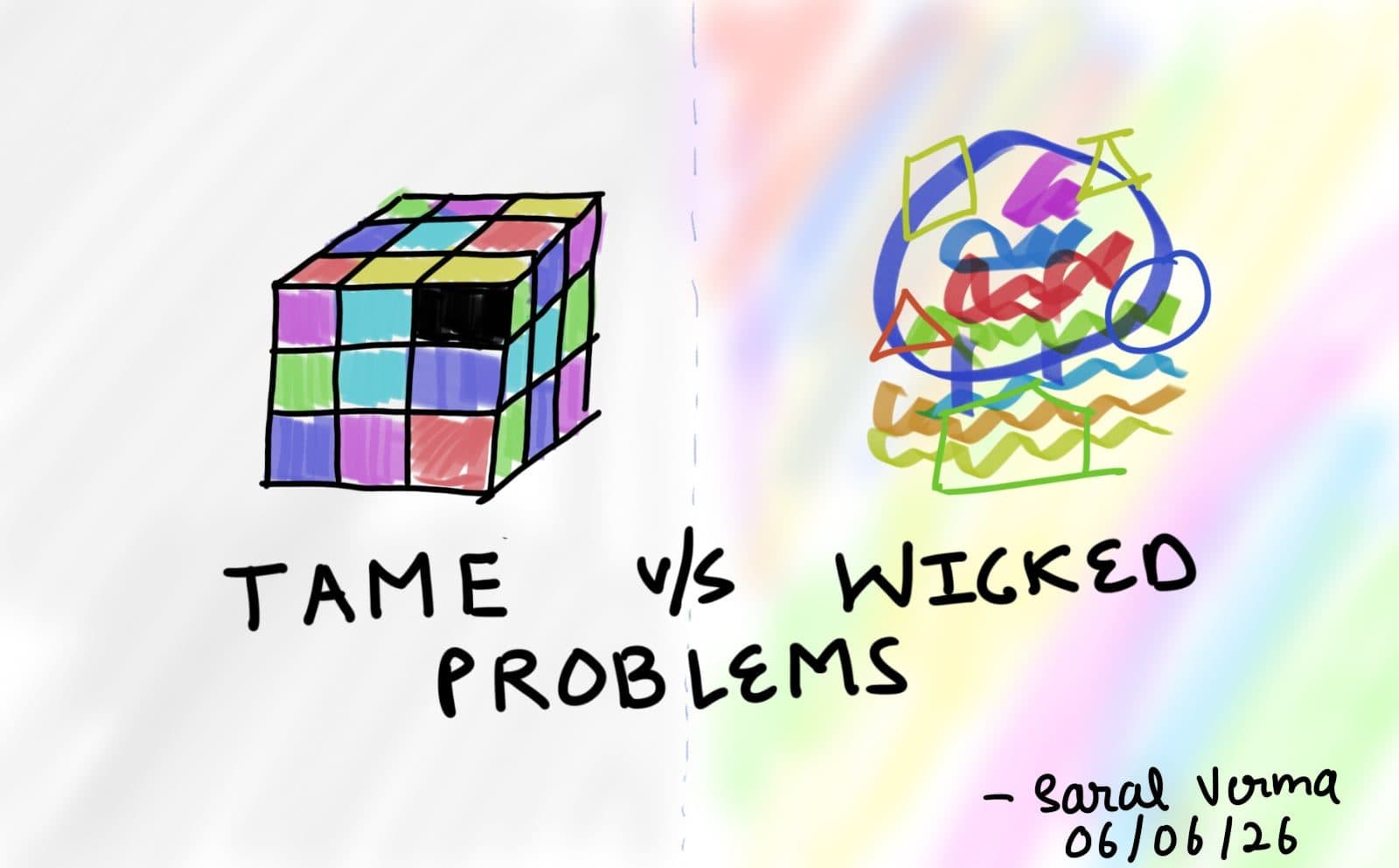
The Cube Has 43 Quintillion Possibilities. The Real World Has More.
In February 2026, a ten-year-old boy named Teodor Zajder solved a Rubik's Cube in 2.76 seconds. The crowd lost its mind. The clip went viral. Teodor became the first human to break the three-second barrier in an official competition [1].
I watched that video three times.
Not because I was impressed by the time. But because I kept thinking: this is what happens when a very smart person attacks a very structured problem.
The cube has 43 quintillion possible configurations. Mathematicians have proven it can always be solved in 20 moves or fewer. The goal is fixed. The rules never change. The environment doesn't shift mid-solve. You practice, you optimize, you get faster. There is a finish line, and everyone agrees on where it is.
Now try running a company like that.
You can't. Because the real world is not a Rubik's Cube.
Tame Problems vs Wicked Problems: A Distinction Nobody Taught You
In 1973, two design theorists named Horst Rittel and Melvin Webber published a paper that most people have never read but everyone is living inside. They introduced the idea of "wicked problems": problems that are ill-defined, have no stopping rule, no definitive solution, and where every attempt to solve them changes the problem itself [2].
Poverty is a wicked problem. Building a startup is a wicked problem. Figuring out how to market to people who don't yet know they want what you're selling is a wicked problem.
The Rubik's Cube is not. Rittel and Webber called these "tame problems." Clear goal. Known variables. A solution that is objectively correct or incorrect.
This distinction matters enormously, because our education systems, our hiring processes, and our cultural definitions of "smart" are almost entirely built around tame problems.
Think about it. Exams have answers. Entrance tests have correct responses. Even most job interviews are just structured problem evaluations dressed up in a conference room. We have gotten exceptionally good at identifying people who can solve problems that have already been defined for them.
And then we wonder why so many brilliant people struggle the moment the scaffolding comes down.
Academic Intelligence vs Practical Intelligence: The Research Nobody Talks About
Robert Sternberg, one of the world's most cited intelligence researchers, spent decades arguing something that still makes academic circles uncomfortable: academic intelligence and practical intelligence are not the same thing, and they don't even strongly correlate with each other.
His research found that practical intelligence scores predict job success about as well as, and sometimes better than, IQ [3]. A study in rural Kenya found that children with high tacit knowledge of the real world performed poorly in school and exceptionally well in life [3]. Research from the University of Maryland found that practical intelligence combined with strong goals predicted entrepreneurial success 27% of the time [4]. Studies consistently show correlations of 0.20 to 0.40 between practical intelligence and real-world job performance, even after controlling for IQ entirely [3].
In other words, IQ explains some of your performance. But the ability to navigate ambiguity, make decisions with incomplete information, and figure your way through a situation nobody has pre-defined for you: that predicts a different kind of outcome entirely.
The absentminded professor is not a caricature. It is a documented phenomenon. The person who can derive differential equations on a whiteboard sometimes cannot read a room, cannot pivot when a plan fails, cannot make a decision without knowing all the variables first. Because "I don't know all the variables" was never part of the training data.
Why Speedcubing Exists and Speed-Startups Don't
There are global competitions for solving Rubik's Cubes. A governing body. World records. In 1982, the first world champion solved it in 22.95 seconds. Today the best in the world average under four.
That progress is possible because the problem is fixed.
You cannot have a competitive circuit for building companies the same way. No two companies are solving the same problem in the same context with the same market at the same time. A strategy that worked for Flipkart in 2012 would fail for any company trying to copy it today. The market has moved. Consumer behavior has changed. The competitive landscape is unrecognizable.
This is what separates genuine innovation from clever execution. Clever execution is fast. It optimizes within known constraints. Innovation redraws the constraints entirely. And you cannot optimize your way into redrawing constraints. You have to tolerate not knowing what the new shape looks like until you have made enough moves to see it.
Research on entrepreneurial psychology consistently finds that tolerance for ambiguity is one of the strongest differentiators between those who build something and those who never quite begin. A 1982 study from the Academy of Management found that entrepreneurs score significantly higher on ambiguity tolerance than managers [5]. Research in the Journal of Innovation and Entrepreneurship found that people who best tolerate ambiguity are also the most innovative [9]. A study involving 1,274 adolescents found that those with high ambiguity tolerance scored better on creativity tests and exhibited lower anxiety levels [6].
To be clear: none of this is against speedcubers. I genuinely love watching them. The pattern recognition, the muscle memory, the years of deliberate practice compressed into under three seconds. It is extraordinary. This is not about the people. It is about the type of problem, and what happens when we confuse excellence at one kind with readiness for another.
Speedcubers need to be fast. Builders need to be tolerant. These are different skills and we barely train one of them.
The Education Gap Nobody Talks About
Harvard Business Review research found that only 4% of college dropouts go on to found successful companies [8]. 62% of unicorn founders hold post-graduate degrees [8]. The average age of founders behind America's largest growth startups is 45, not 22 [7]. Founders with at least three years of prior industry experience were 85% more likely to launch a highly successful startup [7].
This is not an argument for staying in school. It is an argument against the wrong interpretation of both data points.
The dropouts we celebrate are famous precisely because they are exceptions. They left structured environments not because they rejected learning, but because they had identified an unstructured opportunity that couldn't wait.
The 62% who stayed succeeded not because they solved more tame problems correctly. They succeeded because at some point, whether in school or after, they accumulated enough exposure to failure, ambiguity, and imperfect decisions that they built a tolerance for the feeling of not knowing.
The degree is incidental. The tolerance is everything.
How to Actually Get Good at Unstructured Thinking
Tolerance for ambiguity is not just a personality trait you are born with. Research treats it as a trainable capacity. Here is what the evidence actually suggests.
Quiz yourself before you look things up. Before Googling the answer, spend sixty seconds asking yourself what you already think and why. This is Socratic self-interrogation: examining your own assumptions before importing someone else's conclusions. Research from medical and legal education confirms that Socratic questioning is a statistically significant predictor of performance on logical reasoning tasks [12]. The habit of asking "What do I think and what is that based on?" before reaching for certainty is one of the most transferable cognitive skills you can build.
Take a route home without GPS. This is not a metaphor. A Nature study found that habitual GPS use is associated with a steeper decline in hippocampal-dependent spatial memory over time [10]. The hippocampus, the brain region responsible for spatial navigation and memory consolidation, atrophies when it stops being used for active navigation. London taxi drivers who navigate complex city routes without GPS show measurably larger hippocampal grey matter than their counterparts [11]. When you navigate without directions, you are forced to build and update a mental model in real time with incomplete information. That is exactly the cognitive muscle that unstructured problems require.
Put yourself in situations with no defined win condition. Join a group where you are not the expert. Take on a project with no clear deliverable. Start something without knowing what it is supposed to look like in six months. Research consistently shows that individuals who engage with multiple unfamiliar domains score higher in fluency, flexibility, and originality than those who stick to single-domain expertise [9]. Ambiguity tolerance, one study found, fully explained the difference in creative output between the two groups [9].
Ask better questions, not more questions. Research found a curvilinear relationship between ambiguity tolerance and creative output [9]. Too little tolerance and you close off too early. Too much and you never converge on anything. The skill is not sitting in chaos indefinitely. It is knowing when to push further into uncertainty and when to commit to a direction with what you have. The best founders, writers, and strategists are not the most comfortable with not knowing. They are the most skilled at knowing when they have learned enough to move.
Smart Gets You Into the Room. Figuring It Out Gets You Through It.
Smart is a fast solver. Innovative is a good question-asker.
Smart works best when the cube is in front of you. Innovative works best when nobody has told you what the cube looks like yet.
The world will always reward solvers. Exams, competitions, job interviews, performance reviews. These are all built for people who are fast and accurate within known constraints.
But the problems worth working on are almost never within known constraints. The ones that matter are wicked. They shift. They resist clean solutions. Every trial counts and none of them are replicable.
There is a world record for solving a Rubik's Cube. There is no world record for figuring out what to build next. There is no leaderboard for tolerating not knowing. There is no competitive circuit for the kind of thinking that matters most.
Which means the only way to get good at it is to practice it in a world that rarely tells you whether you are doing it right.
Maybe that is the point.
References
-
Zajder, T. GLS Big Cubes Gdańsk WCA Competition. World Cube Association Official Results, February 8, 2026. worldcubeassociation.org
-
Rittel, H.W.J. & Webber, M.M. Dilemmas in a General Theory of Planning. Policy Sciences, Vol. 4, No. 2, 1973, pp. 155–169.
-
Sternberg, R.J. et al. The Relationship Between Academic and Practical Intelligence: A Case Study in Kenya. Intelligence, Vol. 29, No. 5, 2001. sciencedirect.com
-
Baum, J.R. Director of Entrepreneurship Research, University of Maryland. Cited in: Practical Intelligence. Mindvalley, October 2025. blog.mindvalley.com
-
Schere, J.L. Tolerance of Ambiguity as a Discriminating Variable Between Entrepreneurs and Managers. Academy of Management Proceedings, Vol. 1, 1982, pp. 404–408.
-
Stoycheva, K. Ambiguity Tolerance and Creativity in Adolescents. Study involving 1,274 participants, 2015. academia.edu
-
Azoulay, P. et al. Age and High-Growth Entrepreneurship. American Economic Review: Insights, Vol. 2, No. 1, 2020. Referenced in: The Myth of the College Dropout. The American Genius, January 2026. theamericangenius.com
-
Harvard Business Review. Research on Unicorn Founders and Education. Referenced in: Forget the College Dropout Myth. drjasonhung.substack.com
-
Lau, S. & Cheung, P.C. Creativity and Tolerance of Ambiguity: An Empirical Study, 2010. researchgate.net
-
Dahmani, L. & Bohbot, V.D. Habitual Use of GPS Negatively Impacts Spatial Memory During Self-Guided Navigation. Scientific Reports, April 2020. nature.com
-
Maguire, E.A., Woollett, K. & Spiers, H.J. London Taxi Drivers and Bus Drivers: A Structural MRI and Neuropsychological Analysis. Hippocampus, Vol. 16, No. 12, 2006.
-
Chew, C., Lin, S. & Chen, Y. Socratic Questioning and Critical Thinking Performance. Referenced in: Socratic Questioning in Psychology. Positive Psychology, July 2025. positivepsychology.com
Letters
If an essay made you think, the next one might too.
Occasional notes on science, psychology, and the experiments I should probably not be running at 2am. No growth hacks. No weekly guilt.
SubscribeKeep reading
Science
You Dream Every Night. You Just Do Not Remember.
On what dreams actually are, what Freud got embarrassingly wrong, and why forgetting them might be by design.
Psychology
Loud Inside
The inside of a quiet person's head is not quiet. On introversion, longer neural pathways, and why silence is a different kind of presence.
Science
Voices Inside the Head
What happens to the brain — and to love — when you live in more than one language.