BlogCulture · 12 min read
A Man in Rain
Rain does not mean sadness. It means uncertainty. On weather, mood, and why an unreadable figure stays with you.
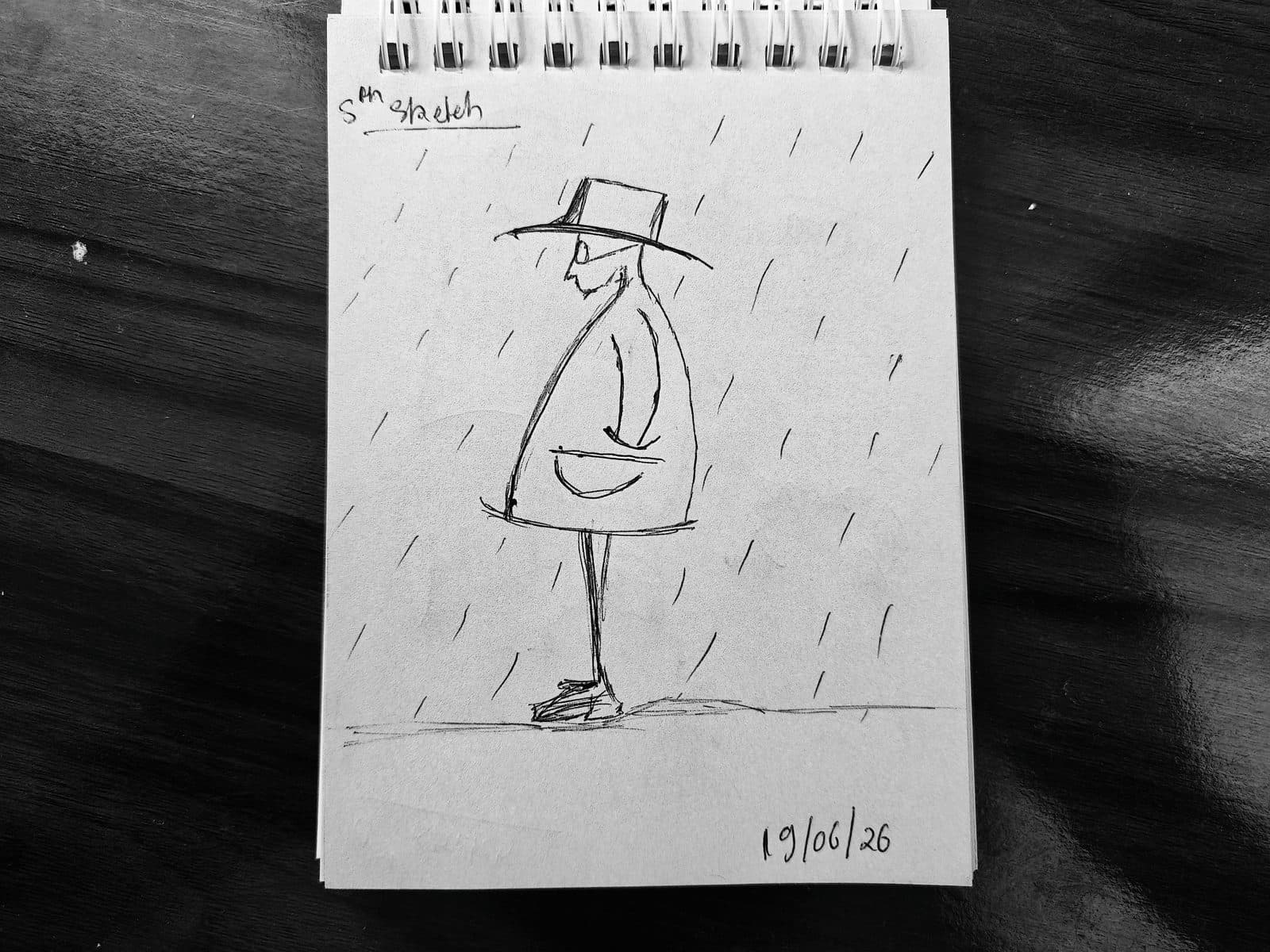
A man standing in rain looks simple at first. There is no obvious event, no dramatic action, and no clear explanation. Still, the image immediately creates a feeling. Most people do not look at such a sketch neutrally. They begin to imagine a story. Maybe he is lonely. Maybe he is waiting for someone. Maybe he is returning home after a difficult day. Maybe he is peaceful. Maybe he is simply standing there because he has stopped caring about getting wet.
That uncertainty is the point.
Rain is often used as a shortcut for sadness. In films, songs, novels, and paintings, rain usually appears when something painful has happened. A breakup scene, a funeral scene, a character walking alone, a window shot after bad news, rain has become an easy visual language for emotional heaviness. But that interpretation is too limited. Rain does not automatically mean sadness. A better way to understand it is this: rain creates emotional ambiguity. It changes the scene enough to make us feel something, but it does not tell us exactly what to feel.
This is why a man in rain can feel more powerful than a man who is clearly crying. Crying gives us a direct emotional answer. Rain gives us a situation. The man may be sad, but he may also be calm, tired, thoughtful, relieved, or simply waiting. The image becomes interesting because it does not close the meaning. It gives the viewer enough information to care, but not enough information to be certain.
Weather affects mood, but not in a simple way
There is a common belief that rainy weather makes people sad and sunny weather makes people happy. It sounds true because many of us have felt our energy change with the weather. But research shows that the relationship between weather and mood is more complicated than the cliché.
A 2008 study by Denissen, Butalid, Penke, and van Aken studied daily mood reports from 1,233 people and compared them with actual weather station data. The researchers examined temperature, wind power, sunlight, precipitation, air pressure, and photoperiod. They found that weather did have statistically significant effects on mood, but the average effects were small. They also found that people differed in how strongly they reacted to weather [1].
This matters because rain does not affect everyone in the same emotional direction. For one person, rain may feel depressing. For another person, it may feel peaceful. For someone living in a very hot place, rain may feel like relief. For someone commuting through traffic, it may feel like inconvenience. For someone who connects rain with childhood, memory, music, tea, or sleep, it may feel comforting.
The same weather can carry different emotional meanings depending on the person, memory, culture, place, and situation. So if we immediately say, “the man is sad because it is raining,” we reduce the image. The more accurate interpretation is that rain creates a condition where many emotions become possible. The rain does not explain the man. It makes us wonder about him.
Rain changes the emotional environment
Even if rain does not create one fixed emotion, it clearly changes the emotional environment. A large 2018 study by Baylis and colleagues analysed more than 3.5 billion Facebook and Twitter posts and found that weather conditions such as precipitation, cloud cover, humidity, and very hot or cold temperatures were associated with worse expressed sentiment online [2]. This does not prove that every rainy day makes every person sad, but it does show that weather can influence the emotional tone people express at scale.
The important point is that rain changes the conditions around a person. It reduces light, changes sound, affects movement, creates discomfort, and alters how people behave in public spaces. People walk faster, look down more, open umbrellas, search for shelter, avoid unnecessary conversation, and become more physically guarded. A normal street becomes a different kind of space when it rains.
This is why rainy scenes often feel heavier than clear weather scenes. Rain adds pressure without adding explanation. It makes the body more aware of the environment. Wet clothes, cold air, slippery roads, traffic noise, reflections on the street, and the smell of wet ground all make the scene feel more physical. The viewer can almost imagine what it feels like to stand there. That sensory detail makes the image emotionally stronger.
Ambiguity makes the viewer participate
The man in rain works because it is ambiguous. If an image is too obvious, the viewer understands it quickly and moves on. If it is too confusing, the viewer may disconnect. But when an image is partly understandable and partly unresolved, the viewer stays with it longer. The mind tries to complete what the image has left open.
Research in art psychology supports this idea. Jakesch and Leder studied ambiguity in art appreciation and found that ambiguity can affect both interest and liking. A certain level of ambiguity can make artworks more engaging because the viewer has to search for meaning [3]. Later research by Muth, Hesslinger, and Carbon also argued that ambiguous artworks can be appealing when they give the viewer an opportunity to resolve uncertainty or experience insight [4].
This explains why a simple sketch of a man in rain can create a strong response. The viewer knows what is physically present: a man, rain, maybe a street, maybe an umbrella, maybe a coat. But the emotional meaning is incomplete. That incomplete meaning invites interpretation. One person may see loneliness. Another may see patience. Another may see exhaustion. Another may see acceptance. The image becomes personal because each viewer brings something of their own to it.
Rain makes people harder to read
Rain also changes how we read a person physically. In clear weather, we may understand a person through their face, posture, eye contact, walking speed, or gestures. In rain, many of these signals become hidden or distorted. A person may lower their head, cover their face, hold an umbrella, close their shoulders, or walk differently because of wet ground and discomfort.
This makes the figure less readable. When the face is hidden or the body is guarded, the viewer has less emotional information. That lack of information creates room for projection. We are not only seeing what is there. We are imagining what might be there.
This is one reason the image of a man in rain feels private. The rain creates a physical barrier between him and the world. It separates him from other people. Even if he is standing in a public place, he appears internally distant. We can see him, but we cannot fully know him. That gap between visibility and unknowability is emotionally powerful.
In real life, this is also how people often exist. We see bodies, faces, clothes, posts, messages, and behaviour, but we rarely know the full inner story. A quiet person may not be sad. A serious person may not be rude. A person standing alone may not be lonely. The sketch becomes interesting because it reminds us how much we assume from very little information.
Rain is sensory, not just symbolic
Rain is not only a symbol. It is also a sensory experience. It has sound, smell, temperature, texture, and memory attached to it. The smell commonly associated with rain on dry ground is called petrichor. The term was introduced by Isabel Joy Bear and Richard Thomas in a 1964 Nature paper, where they studied the distinctive earthy smell released when rain falls on dry soil or rock [5].
This detail matters because rain scenes can feel emotionally rich even when nothing dramatic is happening. Rain does not only change what we see. It activates other senses and memories. The viewer may imagine wet air, cold clothes, the sound of vehicles on wet roads, the feeling of water on skin, or the quietness that comes when rain separates people into their own small spaces.
That is why rain is used so often in visual storytelling. It immediately changes the emotional texture of a scene. But the better use of rain is not to force sadness. The better use is to create atmosphere, pressure, and uncertainty.
The image also feels modern
A man in rain feels especially modern because it fits the emotional experience of cities. In cities, people are constantly visible but often not understood. You can stand in a crowd, walk through traffic, sit in a metro, or pass hundreds of people in a day and still remain emotionally unknown.
Rain makes this condition more visible. People hide under umbrellas, lower their heads, rush past one another, and become more focused on reaching shelter. The public space becomes full of bodies but low on connection. Everyone is near, but everyone is also separate.
This is why a rainy street scene can feel lonely even when it is crowded. The loneliness is not only about being physically alone. It is about being unread. A man standing in rain becomes a symbol of that condition: visible from the outside, hidden on the inside.
The mistake is diagnosing the man
It is also important not to overinterpret the image. A rainy scene can feel heavy, but that does not mean the man is depressed. Sadness, reflection, tiredness, and clinical depression are not the same thing.
Seasonal Affective Disorder, for example, is a recognised depressive condition connected to seasonal patterns. The National Institute of Mental Health describes it as a form of depression that occurs during specific seasons and can include symptoms such as low energy, persistent sadness, sleep changes, concentration problems, and loss of interest [6]. That is very different from saying a rainy image looks emotional.
This distinction matters because we often use weather language too casually. We say a grey sky is depressing or rain is sad, but real emotional states are more complex than that. The man in rain might be sad. He might also be calm, bored, patient, tired, relieved, or simply waiting for transport.
Rain can suggest emotion. It cannot prove emotion. That is exactly why the image is interesting.
Conclusion
A man in rain is not powerful because rain means sadness. He is powerful because rain creates uncertainty. It changes the environment, hides emotional signals, activates sensory memory, and gives the viewer space to interpret what might be happening.
The research supports a more nuanced view. Weather can affect mood, but the average effects are often small and vary across people [1]. Large scale social media research shows that rain and cloud cover can influence expressed sentiment, but that still does not make rain emotionally one dimensional [2]. Art psychology adds another layer: ambiguity can make an image more engaging because viewers participate in creating meaning [3][4].
So the better interpretation is not “this man is sad because it is raining.” The better interpretation is that rain makes the man emotionally unreadable. It opens multiple possibilities at once. He may be lonely, peaceful, tired, waiting, grieving, or simply present in the moment.
The rain does not give us the answer. It makes us ask the question.
References
[1] Denissen, J. J. A., Butalid, L., Penke, L., & van Aken, M. A. G. “The Effects of Weather on Daily Mood: A Multilevel Approach.” Emotion, 8(5), 662-667, 2008. https://doi.org/10.1037/a0013497
[2] Baylis, P., Obradovich, N., Kryvasheyeu, Y., Chen, H., Coviello, L., Moro, E., Cebrian, M., & Fowler, J. H. “Weather impacts expressed sentiment.” PLOS ONE, 13(4), e0195750, 2018. https://doi.org/10.1371/journal.pone.0195750
[3] Jakesch, M., & Leder, H. “Finding meaning in art: Preferred levels of ambiguity in art appreciation.” Quarterly Journal of Experimental Psychology, 62(11), 2105-2112, 2009. https://doi.org/10.1080/17470210903038974
[4] Muth, C., Hesslinger, V. M., & Carbon, C.-C. “The Appeal of Challenge in the Perception of Art: How Ambiguity, Solvability of Ambiguity, and the Opportunity for Insight Affect Appreciation.” Psychology of Aesthetics, Creativity, and the Arts, 9(3), 206-216, 2015. https://doi.org/10.1037/a0038814
[5] Bear, I. J., & Thomas, R. G. “Nature of Argillaceous Odour.” Nature, 201, 993-995, 1964. https://doi.org/10.1038/201993a0
[6] National Institute of Mental Health. “Seasonal Affective Disorder.” https://www.nimh.nih.gov/health/publications/seasonal-affective-disorder
Letters
If an essay made you think, the next one might too.
Occasional notes on science, psychology, and the experiments I should probably not be running at 2am. No growth hacks. No weekly guilt.
SubscribeKeep reading
Culture
you are still a kid
Calling someone a kid is not a description. It is a power move. On gerontocracy, freedom, and the first generation with the language to push back.
Culture
Good at Looking Good
On moral performance, the psychology of public correction, and why doing visible small things can replace doing meaningful large ones.
Culture
The Quiet Crisis of the Comfortable
On frictionless lives, hollow mornings, and the strange comfort of washing your own dishes.