BlogPhilosophy · 8 min read
Detachment in an Age of Metrics
Siddhartha left a life that was already winning. On late-night self-audits, Govinda's tragedy, and what we count instead of seeking.
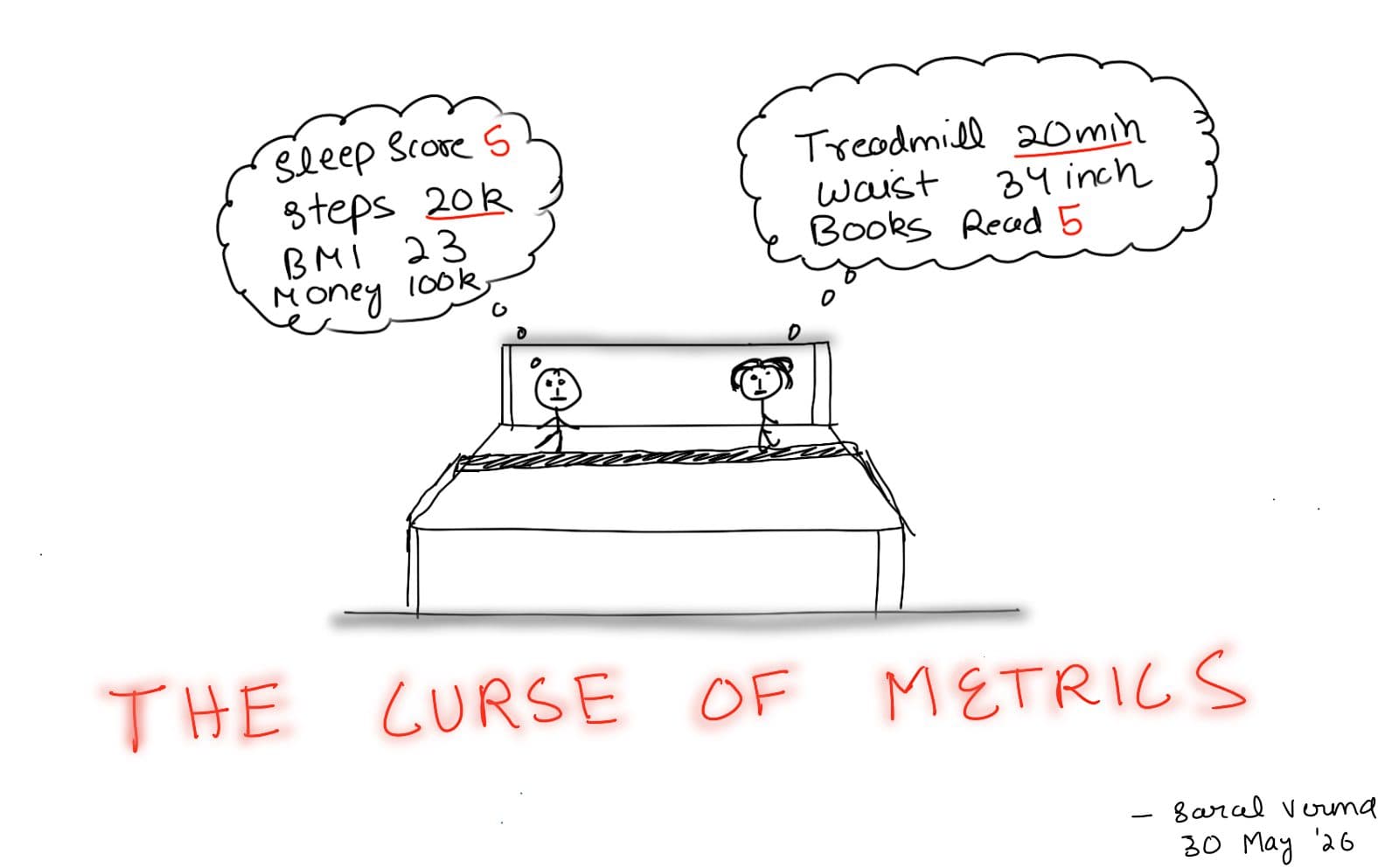
There is a specific kind of anxiety that hits at around 11pm.
You have had a full day. You worked. You ate. You maybe exercised. You read something. And yet you open your phone and start calculating. Did I do enough? Was today productive? How many steps? How many hours of deep work? How many people read what I wrote?
You are lying in bed auditing your own existence.
Siddhartha would have found this deeply, almost comically, sad.
The Boy Who Had Everything and Left
Siddhartha was a Brahmin's son. In ancient India, that meant he had already won. Status, scripture, a future written in gold. People looked at him the way we look at someone with a prestigious degree, a good salary, and a clear LinkedIn trajectory.
He was admired. He was loved. He had a best friend named Govinda who followed him everywhere, devoted and certain that wherever Siddhartha was going, it was worth following.
And Siddhartha left anyway.
Not because things were bad. Because things being good was not enough. Somewhere underneath all the certainty, underneath the rituals and the praise and the path already laid out, he felt something missing. Not unhappiness exactly. More like a persistent hollowness that comfort could not touch.
We know this feeling. We have just built an entire industry around not sitting with it long enough to understand it.
The Samanas: The First Self-Improvement Program
Siddhartha and Govinda joined a group called the Samanas. Forest ascetics. Men who had renounced everything and were engineering their own suffering in pursuit of transcendence.
They fasted until their bodies became hollow. They held impossible postures. They emptied their minds through sheer brutal discipline. They optimised suffering the way we optimise sleep. Methodically. Obsessively. Tracking every deprivation like a metric.
Siddhartha was extraordinary at it. He mastered every technique faster than anyone. He could leave his body through meditation, exist as a bird, as a stone, as nothing at all.
And after three years, he told Govinda: this is not it.
Not because the techniques were wrong. Because techniques were the problem. He realised that no amount of method could give him what he was actually looking for. He could empty himself perfectly and still come back to the same self he was trying to escape.
Sound familiar?
We do this constantly. A new morning routine. A new journaling framework. A new productivity system. A new diet. We optimise the container and wonder why it keeps feeling empty. Siddhartha spent three years in a forest doing the ancient version of this and came back with the same conclusion you probably already know but keep ignoring.
The method is not the answer. You are.
The Moment He Walked Away From the Buddha
This is the part of the book most people miss. And it is the most important part.
Siddhartha and Govinda heard about Gautama. The Awakened One. The Buddha. They walked for days to hear him speak. And when they did, Siddhartha sat there and felt something extraordinary: this man had genuinely found it. Whatever it was, the Buddha had it. You could feel it in how he moved, how he spoke, how he existed in a room.
Govinda was convinced immediately. He joined the Buddha's following that same day. He had found his teacher. He had found his path. He was going to follow it perfectly, diligently, devotedly, for the rest of his life.
Siddhartha refused.
He went to the Buddha himself, respectfully, and said something that must have sounded like madness. He said: your teachings are clear and beautiful. But they cannot give me what I seek. Because the one thing your teachings cannot contain is the experience that gave you those teachings in the first place. You did not become awakened by following someone. I cannot become awakened by following you.
He walked away from the greatest teacher of his age.
We would have made a podcast episode about that teacher and listened to it on our commute.
Govinda: The Tragedy of Doing Everything Right
Govinda is the most heartbreaking character in the book. And nobody talks about him.
He does everything correctly. Every single thing. He follows the Buddha. He learns the teachings. He meditates for decades. He is disciplined, sincere, humble. He gives his whole life to the path.
And at the end of the book, as an old man, he is still searching.
He meets Siddhartha again, not recognising him at first, and asks him: what have you found? What is the secret? Because I have done everything and I still feel like I am missing something.
Govinda is every person who reads every self-help book, takes every course, follows every system, builds every habit, and still lies awake at 11pm running calculations about whether the day was enough.
He is not foolish. He is not weak. He just made one mistake. He outsourced his search to someone else's answers.
What We Did Instead of Seeking
We took the human search for meaning and made it measurable.
Sleep became a score out of 100. Fitness became a streak. Relationships became follower counts and engagement rates. Grief became a healing arc documented in real time. Spirituality became a morning routine with timestamps and before-and-after photos.
We did not abandon Siddhartha's question. We just turned it into a dashboard and called it personal development.
The cruellest part: the metrics feel like progress. Hitting your step count feels like something. Finishing the book feels like something. Growing your audience feels like something. And it is something. Just not the thing you are actually looking for.
Siddhartha figured this out in the forest after three years of perfect discipline. We are taking longer because our forest has Wi-Fi and sends us notifications about how well we are meditating.
Detachment Does Not Mean Not Caring
Here is where most people misread the book.
Siddhartha was not cold. He was not distant. By the end, he loved more completely than he ever had. He wept. He failed as a father. He felt everything with full force. He sat with grief without trying to resolve it.
Detachment did not mean feeling nothing. It meant not needing outcomes to feel whole.
That distinction is everything.
Creating without needing the metrics to validate the creation. Being present with someone without calculating how you appear. Building something without refreshing the analytics. Doing the work and letting it be what it is, not what you need it to become to feel like enough.
We have confused detachment with indifference. So we never practise it. We stay attached to everything, the numbers, the comparisons, the progress bars, and wonder why peace feels so far away.
The River
Near the end of Siddhartha, he becomes a ferryman. He sits beside a river for years and just listens to it.
The river does not try to be anything. It moves. It contains everything at once, joy and grief, past and future, rushing and stillness, and it does not make any of it mean more than it does. It does not track its own flow. It does not optimise its route. It just is, completely, in every moment.
Siddhartha listened to the river until he understood something he could not have read in any teaching: that everything exists at the same time. That the search and the finding are the same movement. That the peace he spent a lifetime chasing was available in any moment he stopped chasing it.
We have rivers too.
A conversation that goes somewhere you did not plan. A walk with no destination and no podcast playing. A sketch made for no one. A meal eaten without your phone beside it. A night where you do not calculate the day.
These are the moments we schedule last and cancel first.
What Are You Actually Counting?
I am 23. I track things. I build things. I write things and check if anyone read them.
I read Siddhartha and something in it sat wrong with me for days. Not because I want to leave everything and sit by a river. But because Govinda's story scared me more than Siddhartha's did.
Govinda did everything right. Followed the best teacher. Practised perfectly. Never stopped trying. And arrived at old age still searching, still asking someone else what the answer was.
The metrics are not the problem. Needing the metrics to tell you whether you are okay is the problem.
Siddhartha's question is not an ancient one. It is the same question underneath every late-night audit of your own day.
What are you actually looking for underneath all the counting?
Sit with that for a minute.
Not to answer it. Just to notice it is there.
References
-
Hesse, H. Siddhartha. New Directions Publishing, 1951. Original German publication 1922.
-
Stanford Encyclopedia of Philosophy. Siddhartha Gautama. plato.stanford.edu
-
Hesse, H. Siddhartha, Chapter: Govinda. The final meeting between Govinda and Siddhartha as aged men.
Letters
If an essay made you think, the next one might too.
Occasional notes on science, psychology, and the experiments I should probably not be running at 2am. No growth hacks. No weekly guilt.
SubscribeKeep reading
Science
You Dream Every Night. You Just Do Not Remember.
On what dreams actually are, what Freud got embarrassingly wrong, and why forgetting them might be by design.
Psychology
Loud Inside
The inside of a quiet person's head is not quiet. On introversion, longer neural pathways, and why silence is a different kind of presence.
Science
Voices Inside the Head
What happens to the brain — and to love — when you live in more than one language.