BlogScience · 13 min read
The Intelligence Metric That Does Not Exist
What IQ actually measures, and why the intelligence that changes your life cannot be tested.
A Test You Can Train For Is Not Measuring What You Think
IQ tests are designed to be hard to game. They are not.
A companion volume to one of the bestselling IQ workbooks states it plainly: thought processes and intelligence scoring can be improved by practising different types of testing [1]. Schools that adopt teaching strategies aligned with IQ test formats produce students who score higher on those same tests, not because they became more capable thinkers, but because they became more familiar with the format [2].
This alone should make you pause. If a measure of "how smart you are" moves meaningfully with practice, what exactly is it measuring? Familiarity, certainly. Pattern recognition within a known structure, definitely. But the thing colloquially called intelligence, the quality that makes someone genuinely formidable at navigating life, was supposed to be more fundamental than that.
It gets stranger. The Flynn effect, named after researcher James Flynn, documents a rise of roughly three IQ points per decade across most of the twentieth century, in dozens of countries [3]. Score people from a century ago against modern norms and their average IQ would be around 70, a score that would today be classified as intellectual disability [3].
Nobody believes humans got that much smarter in three generations. Flynn himself concluded the scores reflect a shift in the way people think due to changes in societal conditions and technology, not a genuine increase in underlying intelligence [4]. More schooling. More abstract symbols in daily life. More practice with the kind of thinking the tests reward.
The test is measuring exposure to a certain cognitive style. It is not measuring some fixed, underlying capacity that exists independent of that exposure.
What IQ Actually Captures, and What It Misses
To be fair to IQ, it is not nothing. The g factor, first identified by Charles Spearman in 1904, captures something real: a general cognitive ability that influences reasoning, problem-solving, learning, and adaptation to new situations, and that correlates across seemingly unrelated tasks [5].
Within this, psychologists distinguish fluid intelligence, the capacity to solve novel problems and reason abstractly without relying on prior knowledge, from crystallized intelligence, the accumulated knowledge and skills built over a lifetime [6]. Fluid intelligence peaks in early adulthood and then declines. Crystallized intelligence keeps growing.
Here is the detail that should change how you think about all of this. Evolutionary psychologist Satoshi Kanazawa found that intelligence scores correlate with the ability to solve novel academic and vocational problems, but do not correlate much with skills in evolutionarily familiar situations: marrying and parenting, forming close friendships, navigating without maps [7].
In other words, IQ predicts how well you do on the kind of problem a test can present to you on paper. It says very little about how well you navigate a relationship, build trust, read a room, or find your way home without a map.
This is not a minor gap. It is close to the entire territory of what makes a life work.
The Problem Is Not the Test. It Is What a Test Can Be.
A 2024 paper in the Journal of Critical Realism in Psychology made an argument that is rarely stated this directly: intelligence tests have unsolvable problems with validity and reliability at the individual level [8]. The researchers note that while group-level statistics may hold, interpreting any single person's IQ score requires both art and science, and should never be assumed to represent more than a narrow guide to a narrow range of capabilities at one point in time [8].
This connects to a deeper concept in research methodology called construct validity. A construct is something abstract that cannot be directly observed, like height can be observed, but must instead be inferred from indicators [9]. Intelligence is a construct. So is wisdom. So is judgment. So is creativity.
The issue is that a construct can never be measured exhaustively or without error [9]. Every test is a proxy, a stand-in, an indirect signal for something that itself remains just out of reach. The map is not the territory, and IQ is a map of a very specific, very narrow piece of territory.
A 2023 study on judgment and decision-making put this even more bluntly in its conclusion: judgments cannot be safely used as proxy tasks for decision making [10]. Even within cognitive science, researchers are finding that the things we use to estimate someone's real-world capability do not reliably predict that capability.
So What Is the Thing That Cannot Be Faked?
If IQ measures exposure and familiarity, and exposure and familiarity can be trained, then what is left that genuinely differentiates people in ways that matter?
Robert Sternberg's triarchic theory offers one answer. Beyond analytical intelligence, the kind IQ tests measure, he identifies creative intelligence, the ability to generate novel solutions, and practical intelligence, the ability to navigate real-world situations effectively [11]. Someone can have low analytical scores and exceptional practical intelligence. The two are largely independent.
But even practical intelligence is just another named construct, another proxy. The deeper answer may be less about naming a new metric and more about recognizing why metrics themselves hit a ceiling.
Here is the pattern across all of this research. Every test that works, works because the problem has a defined shape. Multiple choice. A fixed answer key. A scoring rubric. The moment a problem requires judgment under genuine uncertainty, where there is no answer key because reality has not produced one yet, the test stops being able to follow you there.
This is why situational judgment tests, designed specifically to assess job-related competencies that traditional tests cannot capture, remain notoriously difficult to validate. Researchers note that even a single item with different response options can measure entirely different constructs depending on context [12], and that parallel form reliability, the ability to test the same thing twice in different ways and get consistent results, is rare specifically because it requires the kind of consistency that real-world judgment does not offer [12].
The thing that cannot be faked is not a trait. It is a track record across situations that were never designed to be tested. It shows up in retrospect, in what someone actually did when nobody had written the rubric yet. It cannot be captured in advance because the very feature that makes it valuable, its applicability to problems nobody anticipated, is the same feature that makes it impossible to write a standardized test for.
High IQ Does Not Mean You Are Good at Life
Here is the part the data makes hard to avoid.
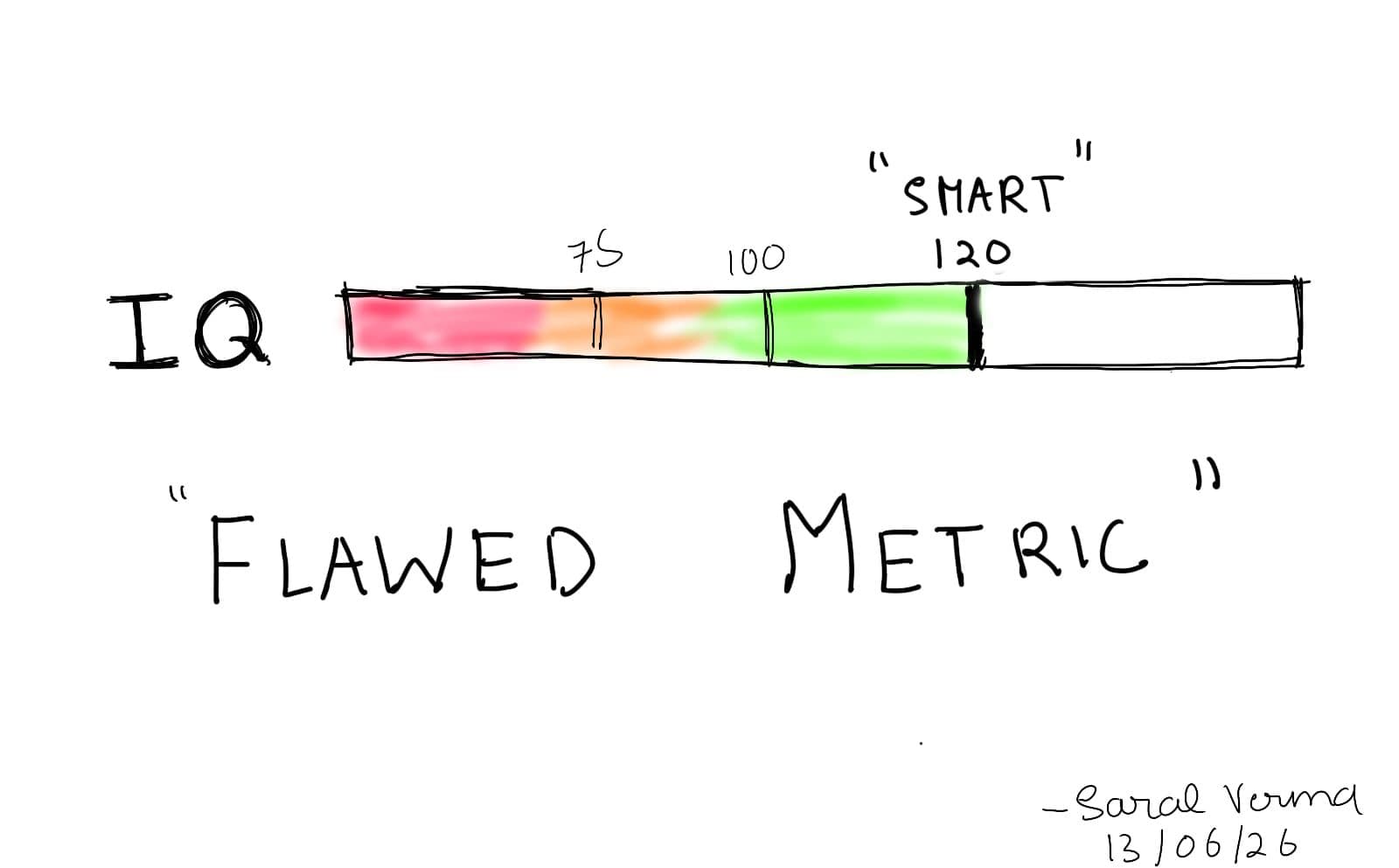
One frequently cited line from research on note-taking and learning states it without hedging: there is no measurable correlation between a high IQ and academic success, at least not above a score of 120 [13]. Past that point, the relationship simply stops.
The happiness data is starker still. A large-scale study found IQ was virtually unrelated to both momentary happiness and life satisfaction, with correlations of -0.04 and -0.001 respectively, statistically indistinguishable from zero [14]. A separate study of 288 adults found that IQ was positively correlated with well-being only through its connection to socioeconomic status. Once income and education were accounted for, the direct relationship between IQ and well-being disappeared entirely [15]. The benefit of a high IQ runs entirely through the doors it opens, not through anything intrinsic to having it.
There is one genuinely interesting finding in the other direction. A study following almost 10,000 people from childhood IQ scores through adult happiness assessments at ages 33, 42, 47, and 51 found that people below average in intelligence experienced significantly more variability in life satisfaction, more emotional ups and downs, than those above average, and this held even after controlling for education, income, and job [16]. So intelligence may buy some emotional stability. It does not appear to buy more happiness, more life satisfaction, or better relationships on average.
The most counterintuitive number in all of this comes from a study by VanTassel-Baska, which found that 63% of gifted students underperform relative to their measured potential [17]. Not failing. Underperforming. Two out of three of the most cognitively able students in a sample were not translating that ability into outcomes. Research into giftedness points to a consistent cause: lopsided development. When a child is identified as cognitively exceptional, focus narrows onto that one capacity, often at the direct expense of emotional regulation, social skills, and the tolerance for failure, leaving a population that is unusually capable on paper and unusually prone to underachievement and imposter syndrome in practice [18].
And the divorce data adds a final twist. Research analyzing Finnish military records found that high mathematical aptitude had no measurable impact on divorce rates, while high verbal fluency contributed significantly to lower divorce rates [19]. Two people can post identical overall IQ scores. One of them is statistically more likely to stay married, because verbal fluency correlates with the ability to detect a partner's mood and communicate about it, a capacity mathematical aptitude does not seem to transfer to at all [19]. A single IQ number can bundle together one capacity that quietly predicts your relationships and another that predicts almost nothing about them, and the test cannot tell you which is which.
This is the piece that resists practice entirely. You cannot study for emotional regulation under genuine stress. You cannot prep for a difficult conversation with your parent the way you prep for an exam, because the exam has a syllabus and the conversation does not. A person can have a remarkable analytical mind and still struggle to apologise, still avoid conflict in ways that quietly damage relationships, still make the same financial mistake three times despite being able to explain exactly why it is a mistake.
Knowing the right answer and being the kind of person who acts on it under real conditions are not the same capability. The first can be tested. The second, so far, cannot.
What This Means For How You See Yourself
If you have ever felt that your IQ score, your test results, or your academic record did not capture something real about how you operate, the research suggests you might be right, and for a specific, well-documented reason.
It does not mean tests are useless. The g factor is one of the most replicated findings in psychology, and it does predict outcomes at a population level [5]. But population-level prediction and individual-level meaning are different things, and the research is explicit that the gap between them is large [8].
What seems to actually matter, the kind of capability that shows up when life hands you a problem nobody pre-defined, when the map runs out, when the relationship needs repair, when the plan needs to change mid-execution, is not something you can train for in the way you train for a test. You can only build it by repeatedly being in situations that have no rubric, and paying attention to what happened.
There may never be a comprehensive metric for this. Not because nobody has tried, but because the moment something becomes a metric, it becomes something you can practice for, and the moment you can practice for it, it stops measuring the thing that made it valuable in the first place.
The test that cannot be gamed is the one that has not been written yet. It is just life, presenting the next problem, and seeing what you do.
References
-
Carter, P. IQ and Psychometric Test Workbook. Companion volume to IQ and Psychometric Tests. alibris.com
-
Penn State University. More School, More Challenging Assignments Add Higher IQ Scores. Research News. psu.edu
-
SimplyPsychology. The Flynn Effect: Explaining Increasing IQ Scores. August 2023. simplypsychology.org
-
EBSCO Research Starters. Flynn Effect. ebsco.com
-
SimplyPsychology. Theories of Intelligence in Psychology: The g Factor. February 2024. simplypsychology.org
-
Cogn-IQ. The g-Factor: What General Intelligence Is and How It's Measured. March 2026. cogn-iq.org
-
Brainscape. Module 60: Intro to Intelligence, citing Satoshi Kanazawa's research on general intelligence and novel versus evolutionarily familiar problems. brainscape.com
-
van Hoogdalem, A. & Bosman, A.M.T. Intelligence Tests and the Individual: Unsolvable Problems with Validity and Reliability. Journal of Critical Realism in Psychology, 2024. journals.sagepub.com
-
Wikipedia. Construct Validity. en.wikipedia.org
-
Decoupling Judgment and Decision Making: A Tale of Two Tails. arXiv preprint, 2023. arxiv.org
-
Cogn-IQ. Spearman's g Factor: What General Intelligence Means. November 2025. cogn-iq.org
-
Christian, M.S. et al. Situational Judgment Tests: Constructs Assessed and a Meta-Analysis of Their Criterion-Related Validities. Personnel Psychology, 2010. mikechristian.web.unc.edu
-
Ahrens, S. How to Take Smart Notes. Referenced widely on the threshold relationship between IQ and academic success above a score of 120. goodreads.com
-
Clearer Thinking. Is IQ Related to Happiness and Life Satisfaction? June 2025. clearerthinking.org
-
Dimitrijevic, A. et al. Study on Intelligence, Emotional Intelligence, and Well-Being. Referenced in: Can Intelligence Buy You Happiness? Scientific American, February 2024. scientificamerican.com
-
Psychology Today. The Surprising Connection Between Intelligence and Happiness. October 2014. psychologytoday.com
-
VanTassel-Baska, J. Cited in: The Relationship Between Social-Emotional Difficulties and Underachievement of Gifted Students. Journal of Psychologists and Counsellors in Schools, 2014. cambridge.org
-
9 Career Challenges Faced by Gifted Adults. Psychology Today, April 2022. psychologytoday.com
-
Aspara, J. Analysis of Finnish Military Records on IQ Type and Divorce Rate. Hanken School of Economics. Referenced in: Do Smart People Get Divorced More? Quora, 2025. quora.com
Letters
If an essay made you think, the next one might too.
Occasional notes on science, psychology, and the experiments I should probably not be running at 2am. No growth hacks. No weekly guilt.
SubscribeKeep reading
Science
You Dream Every Night. You Just Do Not Remember.
On what dreams actually are, what Freud got embarrassingly wrong, and why forgetting them might be by design.
Science
Voices Inside the Head
What happens to the brain — and to love — when you live in more than one language.
Science
The Walls Have Been Talking
On color, light, green spaces, and the invisible design of your emotional life.